Musicians Biographies
Sue Mehess
Violin I

How did you first start playing your instrument?
I started playing in 5th grade when a music teacher from the neighborhood came to my grade school (Potomac View Elementary) and asked if anyone was interested in making music. She played all the instruments that day and I was so impressed that one person could play so many different instruments. I ran home and begged my mom to let me join her class. The rest is history!
Is there a piece the orchestra has played that felt especially meaningful to you? Why?
I love all the Christmas music as it reminds me of my Grandmother. She was awesome. The kindest person I've ever known. I still miss her deeply.
What’s a memorable performance moment—great or disastrous—that stands out?
My first outside concert was way back in 1972. We were invited to play for the grand opening of the new shopping center. It was raining and windy while only a few people showed up but it was still the most enjoyable time. I was showing off my craft and felt like I had accomplished something big. I knew I wanted to be a performer from that day on.
What’s something you’re currently working to improve as a musician?
I'm currently working on making my music sound more lyrical... not just notes on a page but giving them life to tell their story... so to speak...
What does playing in a community orchestra mean to you personally?
I love playing with a community orchestra (especially this one!) as we are all serious about our music but still have fun doing it. It's the high point of my week to go to rehearsal and see everyone, it's like a weekly family reunion!
Who has been the biggest musical influence in your life?
My dad has been the biggest influence in my musical life. He always told me to do my best without fear of failing. Everybody makes mistakes, but learning from them is the trick!
Ryan Frederick
Principal Viola

I started viola around 2000 in elementary strings, and then was in Corvallis Junior Symphony and Corvallis Youth Symphony in high school. I was in Willamette Valley Symphony while in college and Pro Musica Corvallis while in grad school.
Is there a piece the orchestra has played that felt especially meaningful to you? Why?
In 2023 when we did the Americana concert, I really enjoyed the piece “Our Wings Have Caught the Wind” by John Keltonic. That piece had a lot of great energy with the fast-moving strings’ parts and some incredible wind parts, especially for the brass. Getting it to speed was a challenge but very worth it.
How do you prepare differently for solos or exposed passages?
For solos with tricky positioning (such as the harmonics solo I had to do a bit ago), I play around with how I’m going to approach it early on so that I make key choices at an early stage. Then I work on that approach at a slow tempo and then spend time with a metronome to get to concert tempo. It’s important to focus on these passages earlier in the season so that more rehearsals can be spent integrating them with the orchestra.
What’s a memorable performance moment—great or disastrous—that stands out?
When I was with the Corvallis Youth Symphony, we had the pleasure of having Pink Martini join us for one of our concerts. That was an incredible and electric experience. A much more recent great experience with WCYO was our concert last winter. Due to our closeness to the audience in the church concert, when the audience stood up and joined in for Auld Lang Syne at the end of “It’s a Wonderful Life”, we could feel a lot of joy and excitement from them.
How do you balance practicing with work, family, or other commitments?
I try to aim for practicing consistently, which doesn’t always mean practicing for a long time if time doesn’t allow, but sometimes just means focusing on a small goal within some passages that I want to improve.
What’s something you’re currently working to improve as a musician?
I’m trying to learn ukulele as I’ve wanted to learn something in the guitar family for a while. Some skills transfer but it's also giving new challenges that are helping me think about music/theory from a different perspective.
What does playing in a community orchestra mean to you personally?
I find performing with a group very rewarding. Compared to solo playing, it calls for dedication to synchronizing with others and working together in real time, which is a great feeling when it all comes together.
Who has been the biggest musical influence in your life?
My private viola teacher when I was younger in Corvallis, Abigail Stoughton, was amazing. I always enjoyed my lessons and learned fundamental skills and approaches to practicing that I continue to use to this day.
What’s the most rewarding part of leading your section?
Though the violas are often hovering around a lower number of players, I think we are still able to deliver a good sound from our section, and it’s always rewarding to everything coming together by concert time.
What advice do you give newer or less experienced section members?
I try to go over the music early in the pre-season/season and point out anything that might be an issue in an email or at rehearsals. At sectional we make sure we're good with rhythm and intonation at key spots at a slower tempo, such that everyone can have a good version in mind.
Alan Bahm
Principal Cello
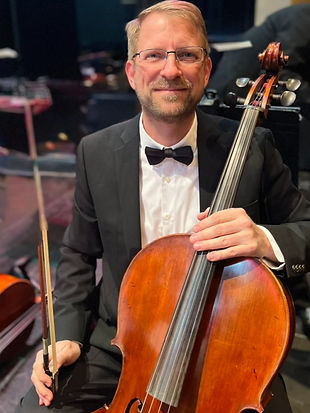
How did you first start playing your instrument?
In 4th grade, there was a public-school program for stringed instruments.
Is there a piece the orchestra has played that felt especially meaningful? Why?
There are many pieces - it is always meaningful to hear present day composers Collin communicates with on works we are doing. Musically, the Gaelic Symphony we played in May of 2024 was so lyrical and beautiful, and the duet between violin and cello was always a treat to hear.
How do you prepare differently for solos or exposed passages?
I try to perform a solo different ways in the rehearsals, to see how it sounds and comes across to the rest of the musicians in the orchestra. They know the music so well, so hearing back from them means a lot.
Do you have any pre-concert rituals or routines?
Breathe, breathe, breathe - to relax the body and mind, and to be energized for the performance.
What’s a memorable performance moment - great or disastrous - that stands out?
Dropping my bow onstage!
How do you balance practicing with work, family, or other commitments?
It’s taken me years to learn how to practice, and I’m still learning how to do it better. Right now, better practicing for me means really listening for what I want to fix, stopping and finding the fewest notes over which the issue shows up, and practicing just that - it’s about efficiency. My family has also been supportive of my time in this, for which I’m really lucky.
What’s something you’re currently working to improve as a musician?
Making intentional musical choices in my playing - working on vibrato, bow articulation, to be expressive in the right way for the musical moment. Also, to understand what the sound is like “out there” in the audience.
What does playing in a community orchestra mean to you personally?
I’m grateful to be able to contribute and support others.
Who has been the biggest musical influence in your life?
My music teachers, Hamilton Cheifetz (cellist), Tomáš Svoboda (composer) who I got to work with at Portland State University, and Clive Greensmith (cellist), who I got to work with at the San Fransisco Music Conservatory in a summer program.
What’s the most rewarding part of leading your section?
Helping out at the sectionals practices we have. Teaching and leading the other cellists has helped me learn so much
What advice do you give new or less experiences section members?
Lean in to anything you enjoy about your instrument, because you will learn faster. Always ask questions - everyone is still learning, even the experts - that’s one of the things that makes music a life-long rewarding pursuit.
Stewart McGinnis
Principal Double Bass

How did you first start playing your instrument?
I started on trumpet in 6th grade. In high school the band director eventually wanted to feed a bass into the high school symphonic band, and I was the only tall enough sixth grader willing.
Is there a piece the orchestra has played that felt especially meaningful to you? Why?
Joining WCYO again after something like 10 years, December 2025’s Intermezzo was a wonderfully lyrical way to feel back at home in an orchestra.
Do you have any pre-concert rituals or routines?
Bass, bow, and music get added to the wallet/phone/keys pat-down with a thorough rosining.
What’s a memorable performance moment—great or disastrous—that stands out?
Once in a pit orchestra for "The Music Man" I had a two-note octave jump solo which picked the music back up. It was small, and felt a little silly seeing "solo" marked above just to notes, but I did my best to make it count!
What’s something you’re currently working to improve as a musician?
I've been working on getting my intonation more confident in the mid-neck positions, and using the whole bow to improve my tone.
What does playing in a community orchestra mean to you personally?
I find it very grounding and fulfilling. It's easy to put all kinds of music on listen enjoy casually, but getting together with real people all taking time out of their day to live the craft? That's special.
Who has been the biggest musical influence in your life?
Claude Debussy. Prior to actually sitting down and giving "Clair de Lune" a good listen, I actually had a slightly antagonistic attitude toward music in general. So without that, I maybe never have come to love it the way I do.
What’s the most rewarding part of leading your section?
It encourages me to immerse myself further into the performance so that I can push the quality of my playing compared to if I didn't have that reminder of people relying on me.
What advice do you give newer or less experienced section members?
Perform with intention. The difference between mere notes on the page and live music that sounds full and makes an impact is how much you choose to put into it.
Morgan Brown
Principal Flute

How did you first start playing your instrument?
When I was about 10 or 11, my mom was playing her Classical Music Records Collection, including Czech Composer, Bedrich Smetana's "The Moldau" in our home. I thought the beginning notes representing the confluence of the cold stream and warm stream to form the Moldau River (Flute 1 & 2 respectively) were the most *wonderful sounds* I have EVER heard.
Is there a piece the orchestra has played that felt especially meaningful to you? Why?
Hard Question, so many, many pieces have special moments and memories! In addition to "The Moldau", I love many pieces such as Debussy's "Prelude to an Afternoon of a Faun", Grieg's "Peer Gynt", and hundreds of other pieces--each with their special charm and challenges!
How do you prepare differently for solos or exposed passages?
I regularly enlist the assistance of internationally known Flute Coach/Teacher, Dr. Sydney Carlson, as well as often recruit friends & colleagues for their thoughts and advice.
Do you have any pre-concert rituals or routines?
As Principal, I try to arrive extra early as I am not a fan of adding stress to a performance event. I also allow for traffic problems and other variables. Arriving early also allows for ample time to check lighting, air vents, stability of chair and Manhasset stand plus other potential stage issues. I also make sure our Flute Section has enough room for several of us on our horizontal instruments.
How do you balance practicing with work, family, or other commitments?
This is a life skill professional and amateur musicians both must master.
Co-workers, friends and family all can help the musician in many ways so "... it takes a village to raise a musician". Support from all is invaluable to the orchestral musician. Without learning to use your personal & professional resources (I used to practice for RCFC on my lunch hours in the office building basement, for example) to best expediency, you are likely to be more reactive than proactive. It is an ongoing issue but the rewards are well worthwhile!
What does playing in a community orchestra mean to you personally?
An opportunity to explore and evolve in a unique universe of expression. Oh, and FUN!!
Who has been the biggest musical influence in your life?
Many influences, large and small. I've been lucky to have personal influences and experiences
from family to friends to hearing Sir Galway (& Rampal and others) to having heard a sound without which life would be less than it can be.
What's the most rewarding part of leading your section?
I enjoy being part of a team and enjoy the successes of mutual problem solving.
What advice do you give newer or less experienced section members?
Never give up, never stop learning. We are finite but music can bring infinite joy and
fulfillment.
Crystal Loman
Flute II

How did you first start playing your instrument?
I started playing Flute in 6th grade school band.
What’s something you’re currently working to improve as a musician?
I'm working on improving and memorizing practice pieces that I already feel confident playing instead of just moving on to the next new piece. I'm trying to look at nuanced things like phrasing and shape to improve my overall musicianship.
What does playing in a community orchestra mean to you personally?
I feel honored to be part of this group. I love that WCYO works to provide FREE high-quality concerts to the public. I admire the dedication of my fellow members who are all positive and encouraging. Thank you for giving me a chance to play in a group again!
Leslie Wagner
Principal Bassoon

How did you first start playing your instrument?
In 8th grade, I had a student teacher (for band) who was a bassoonist. I was playing clarinet, and she started me on bassoon.
Is there a piece the orchestra has played that felt especially meaningful to you? Why?
I really enjoyed the Copeland pieces we played a couple of years ago. Also, "How Can I Keep from Singing" that we did in December 2025, it brought tears to my eyes!
Do you have any pre-concert rituals or routines?
I generally don't eat a lot before a concert, so usually I will have a sweet treat and a glass of wine afterward.
What’s a memorable performance moment—great or disastrous—that stands out?
I had a chance to play in Carnegie Hall with my college symphonic band. It was 40 years ago, so I don't remember the program, but it was a great experience!
What’s something you’re currently working to improve as a musician?
I teach music at a local pre-school, and it's surprising how much I learn from finding music to share with the kids. I often find new pieces I was unaware of, or find new ways to understand how music works.
What does playing in a community orchestra mean to you personally?
I've always found music to be a great way to connect with other people. I love the feeling of community with both the musicians and the audience!
Who has been the biggest musical influence in your life?
Mr. Pineno (affectionately known as Uncle Frank) taught me clarinet in fifth grade and was my high school band director. For decades, he inspired many future musicians in my small hometown.
What’s the most rewarding part of leading your section?
We have so many talented musicians in our wind section. It's a joy to play with these dedicated people.
What advice do you give newer or less experienced section members?
Listening is the most important part of playing in an ensemble.
Cass Jones
Principal Clarinet

Is there a piece the orchestra has played that felt especially meaningful to you? Why?
Weber’s Invitation to the Dance that the orchestra performed for the Spring 2025 concerts stands out to me. For one, that was the first concert series I had played with the orchestra. Invitation to the Dance also features a beautiful clarinet line at the beginning of the piece which I was given the honor of playing. Those things combined just felt like a special, personal invitation from the orchestra to welcome me as part of the group.
Do you have any pre-concert rituals or routines?
I make sure I have eaten and am hydrated. Most importantly, I make sure my concert attire is comfortable.
How do you balance practicing with work, family, or other commitments?
My honest answer is that it’s difficult. Life is busy, but never too busy for this little hobby of mine! During rehearsals, I’m able to narrow down specific areas in the music that I do need some practice on. This helps focus my home practice sessions and keep them timely, yet effective.
What’s something you’re currently working to improve as a musician?
Projection through the orchestra is something I’m always striving for. I mainly played in concert bands before starting with WCYO, so I was used to sitting in the first two rows of the group with at least one or two other clarinetists playing the exact same part as me. Now, I am further back in the orchestra, and I’m playing my part alone. It’s something I am constantly aware of and listening for.
What does playing in a community orchestra mean to you personally?
As a woodwind player, WCYO offers me a very special opportunity. Most orchestral woodwind positions are filled by professional musicians. Community orchestras are also not as common as community concert bands, so this is a truly special experience for me!
Who has been the biggest musical influence in your life?
My grandpa— he was the reason I wanted to start fifth grade band. He played the alto saxophone, and that’s what I wanted to play. My music teacher required everyone interested in sax to start on clarinet first, and I never looked back!
What advice do you give newer or less experienced section members?
Have fun and do your best! We’re all at different levels, and WCYO is a safe place to make mistakes.
#freeclassicalconcerts #hillsboro #communityorchestra #clarinet
Ashley Bleiler
2nd Clarinet

How did you first start playing your instrument?
Clarinet was the instrument I chose in 4th grade for the elementary band, and I've stuck with it ever since!
What’s a memorable performance moment—great or disastrous—that stands out?
In 8th grade, my school's jazz band had me join them for a Dixieland piece, Down By the Riverside, in which I was featured and had to solo. I had never done a jazz improvisational solo before, so it was quite scary, but it was a great way to step out of my comfort zone.
What’s something you’re currently working to improve as a musician?
Playing 16th or even 32nd notes when the tempo is really, really fast.
What does playing in a community orchestra mean to you personally?
I really enjoy working together with a group of like-minded individuals who all are here for the same reason--to create wonderful music.
Jason Robey

Principal Trumpet
How did you first start playing your instrument?
5th grade band. I wanted to play the cool Star Wars part on French Horn so they started me on trumpet. They then kept me there :)
Is there a piece the orchestra has played that felt especially meaningful to you? Why?
My most exciting moment was probably the solo in “Blow, Gabriel, Blow” by Cole Porter as a part of the musical “Anything Goes” that I got to play in the pit for at a local high school performance. It was fantastic to be a part of the performance as the students were dancing and singing and I got to fill the Gabriel trumpet voice. Amazing!
Do you have any pre-concert rituals or routines?
Not per se. I will have a reverse plan worked out from the time of the concert start. Working through the steps of dressing up, verifying my gear, and getting into the right spot with my section setup for success usually keeps my nerves down and allows me to get excited to play for folks.
How do you balance practicing with work, family, or other commitments?
As a community member making a living elsewhere, this is tough. My family is really supportive of my practice sessions. I work from home most days and having my trumpet set up in my office allows me to get a good 30 minute warmup session doing my mouthpiece work and then adding my trumpet during my breaks. I can run my technical and concert work shortly after work and mostly be done by the time the family is ready for dinner. I also mark my work calendar with orchestra events to cover the times I need to focus on music.
What does playing in a community orchestra mean to you personally?
After taking a break for about ten years and sitting down with the orchestra for the first time last summer, I realized how much I was missing out on. There is something deeply satisfying for me to perform with a group and to play both challenging and exciting material.
Who has been the biggest musical influence in your life?
Mr. Wells, high school band teacher, at Billing West High School was one of my biggest influencers early on. Between that and my church play and musical performances, I always wanted to keep growing and excelling in music. I enjoy being challenged constructively and have very fond memories of all the musical groups I played with in High School.
What’s the most rewarding part of leading your section?
I enjoy performing as a brass group singing serenades and unleashing delightful surprises for our audience.
What advice do you give newer or less experienced section members?
Always make a beautiful sound :) Hard work and prep outside of rehearsal let’s everyone in the orchestra make a beautiful sound together.
Chad Rue

Principal Oboe
How did you first start playing your instrument?
I saw an oboe in a Junior High music class and became fascinated by double reed instruments. I decided I wanted to try it, and I eventually convinced my parents to buy an oboe and arrange lessons for me.
Is there a piece the orchestra has played that felt especially meaningful to you? Why?
I was captivated by several of the pieces we played in our concert of female composers. I think we can all acknowledge that there are some differences in the way men and women think and approach problems. I think some of those differences found their way into the musical expressions of these composers. I really enjoyed getting to know those pieces. It was an interesting and refreshing experience.
How do you prepare differently for solos or exposed passages?
The oboe is featured pretty frequently, and sometimes I do find it stressful. I don’t really have a different technique to prepare for solos. I listen to the recordings to get a sense of how professionals approach those passages, but in the end, I try to play them in my own way. It helps to remind myself that people are generally not as critical as I am of myself!
Do you have any pre-concert rituals or routines?
I almost always go to our concerts directly from my work, so my pre-concert ritual consists of putting on my fancy concert dress in our company dressing room, amidst the lockers and the athletic equipment. I keep hoping I’ll run into a colleague on the way out, so we can share a clever comment or two, but so far that hasn’t happened!
What’s a memorable performance moment—great or disastrous—that stands out?
I’ll describe both! I got to perform two particularly memorable pieces: Brahms Symphony No 1, and Bartok Concerto for Orchestra. In both cases, I got totally caught up in the moment, and I felt like I was literally a part of the music. I had a feeling of being united with my fellow musicians in creating something beautiful and amazing. It went beyond a simple performance. It’s hard to describe, but I’ll always remember it. One disastrous moment: I was swinging my oboe up from my lap just seconds before a solo, and I smacked my reed against the bottom of the music stand. That was horrifying, and it went as badly as you might imagine!
What’s something you’re currently working to improve as a musician?
Reed making! I’ve been playing oboe for 40 years, and I’m still trying to master that art. They say that to get good at oboe reed making, you have to make enough reeds to fill a laundry basket. I think my basket is still half empty.
What does playing in a community orchestra mean to you personally?
I knew early on that I was not going to be a professional musician, but I promised myself that I’d continue to play in some capacity. However, music fell by the wayside as I focused on graduate school and my first job. My poor oboe sat untouched and gathering dust for over a decade. Then, on a whim one Christmas break I decided to haul out my oboe and see if I could still play. It stirred something I guess, because I decided to start taking lessons again and revitalize that old part of me. When the opportunity to play in WCYO came around, I knew it was the perfect chance to fulfill the promise I made to myself all those years ago. It’s been great to have a place to play again.
Bennett Battaile
Principal Tuba

How did you first start playing your instrument?
Mom told my brother and me that we had to try music for a year. Oh, Mom, OK fine. No particular experience and certainly no aptitude at that point. Somehow, I knew that a tuba had only three valves, which sounded easy, so I chose that. Thanks to a good band teacher I stuck with it.
Is there a piece the orchestra has played that felt especially meaningful to you? Why?
Sleepers Wake, from the December '25 concert, is one I've liked for decades, even before starting to play an instrument. What made playing it this time memorable is that I'd never before caught on to how complicated and dynamic the harmonies are. I find rehearsing a piece almost always more rewarding than just hearing it, and it was even more true than usual this time.
What’s a memorable performance moment—great or disastrous—that stands out?
Before one of the high school state solo contests I wrote to all the other tuba and euphonium entrants with music we could play as an ensemble to keep the audience entertained while waiting for the final awards. They were almost all up for it! In retrospect I wonder if the audience was truly happy to be serenaded by a tuba ensemble; I hope the spirit of goodwill and collaboration made up for it.
What’s something you’re currently working to improve as a musician?
Modest goal: try to remember to practice more often. Even just warming up daily is something I often end up overlooking.
What does playing in a community orchestra mean to you personally?
For me it's always more fun to play music than listen to it. It's a delight feeling real progress from the first lumpy sight-readings to putting together a performance. I like being part of a group, especially a group with a range of ages and backgrounds.
Who has been the biggest musical influence in your life?
Well, Dad always accompanied me on piano, more skillfully than I realized at the time, and my first band teacher kept me and the other students interested and progressing. Outside those, maybe it was seeing Zakir Hussein performing on tabla (Indian drums) and suddenly with my jaw hanging open realizing that the music world was a lot bigger than I'd thought.
Margretta Brinson
Principal Harp

How did you first start playing your instrument?
I started playing the harp when I was 13 years old. I got proficient enough on the piano and was able to switch to another instrument. Since I grew up going to highland games and listening to Celtic music, I wanted to play the harp. I was introduced to Jill Whitman, principal harpist of the Bellingham Symphonic Orchestra and Yakima Symphonic Orchestra, who is not a Celtic harpist but a classical harpist. She still finds time to help me when I find bonkers harp parts.
How do you prepare differently for solos or exposed passages?
I memorize all of my solo passages. Due to how I play my harp, I am unable to see my music and director at the same time. It also helps because a lot of my solos slowdown in the middle, so I need to have eyes on to make sure I am slowing down correctly.
Do you have any pre-concert rituals or routines?
The Liberty HS concert I bring my children, while the church venue concert is just me and my husband. I enjoy having a "date" concert night with just him, and in return having my children's support on another night.
How do you balance practicing with work, family, or other commitments?
This is the hardest balance of my life. I work a full-time job with kindergarteners, part time job of teaching privately, and full-time mom mode. I need to stay very organized and structured with my practicing. I make notes at the rehearsals of trouble areas, then focus on them during the next week.
What’s something you’re currently working to improve as a musician?
Over the summer, I pick a difficult piece for myself to work through. This keeps my skills going during our break.
What does playing in a community orchestra mean to you personally?
I love sharing the harp with the community. Several times, children and adults have come up to me after the concert to talk about my instrument. Those are my favorite moments of letting them play on my strings and discussing how I play the harp.
Who has been the biggest musical influence in your life?
Holst is one of my favorite composers. I love the planets and how each brings out the emotions of life. My sons also enjoy picking out parts of the planets when they hear it in ads.
What’s the most rewarding part of leading your section?
It is just me and occasionally the piano. I enjoy rewarding myself with a sweet treat when I feel that I did well.
Margaret Smith
Principal Keyboard

How did you first start playing your instrument?
Piano lessons from the 3rd grade.
Is there a piece the orchestra has played that felt especially meaningful to you?
I just love all the Christmas music!
What’s a memorable performance moment—great or disastrous—that stands out?
Playing 3 different keyboards in one concert.
What does playing in a community orchestra mean to you personally?
Playing in an orchestra has been a lifelong dream.
Who has been the biggest musical influence in your life?
A local piano teacher is my biggest musical influence. She took my skills as a pianist from late intermediate to passing a level 10 syllabus exam. They introduced me to the Oregon Music Teachers Association and Oregon Federated Music Clubs, which led me to Marylhurst University and studying with professors from the university.
Michael Tinnesand
Master of Ceremonies

How did you first start playing your instrument?
I started when I retired from full-time work. Before that I couldn't read a note of music.
Is there a piece the orchestra has played that felt especially meaningful to you? Why?
I prefer the classic baroque pieces of music.
What’s a memorable performance moment—great or disastrous—that stands out?
I loved the public service project we did a few years ago where we collected funds for life preservers for Hagg Lake. We performed the theme from the movie Titanic while wearing orange floatation vests.
What does playing in a community orchestra mean to you personally?
I love the feeling of being in the middle of the orchestra when all the harmonies are coming together and reinforcing each other. It is a great metaphor for how we should all be working together in other aspects of our lives.
Who has been the biggest musical influence in your life?
The singer songwriters of the 60s and 70s. The Beatles, James Taylor, Joni Mitchell, Bob Dylan, and many others.